
Last October, a 33-year-old man arrived at Bukit Tinggi Medical Centre (BTMC) in Klang with breathing difficulties and a sense that something was not right. What followed would not only save his life, but also give his heart a better chance of recovery.
At BTMC, he was diagnosed with a heart attack and the medical team moved swiftly to reopen a blocked artery and restore blood flow. But they did not stop there.
They took an extra step to protect his heart by administering TherOx® SuperSaturated Oxygen (SSO2) Therapy, an advanced treatment by ZOLL Medical Corporation used immediately after angioplasty and stenting for those who suffer severe heart attacks.
Approved by the US Food and Drug Administration (FDA), the therapy aims to reduce heart damage and improve recovery.
For the patient, who wished to remain anonymous, the events that led him to BTMC began quietly, when he started having difficulty breathing while alone at home.
“I tried to rest for 30 minutes, but I still found it very hard to breathe,” he shared in a video played during a media session at BTMC on Tuesday.
As the discomfort became harder to ignore, he decided to head to the hospital.
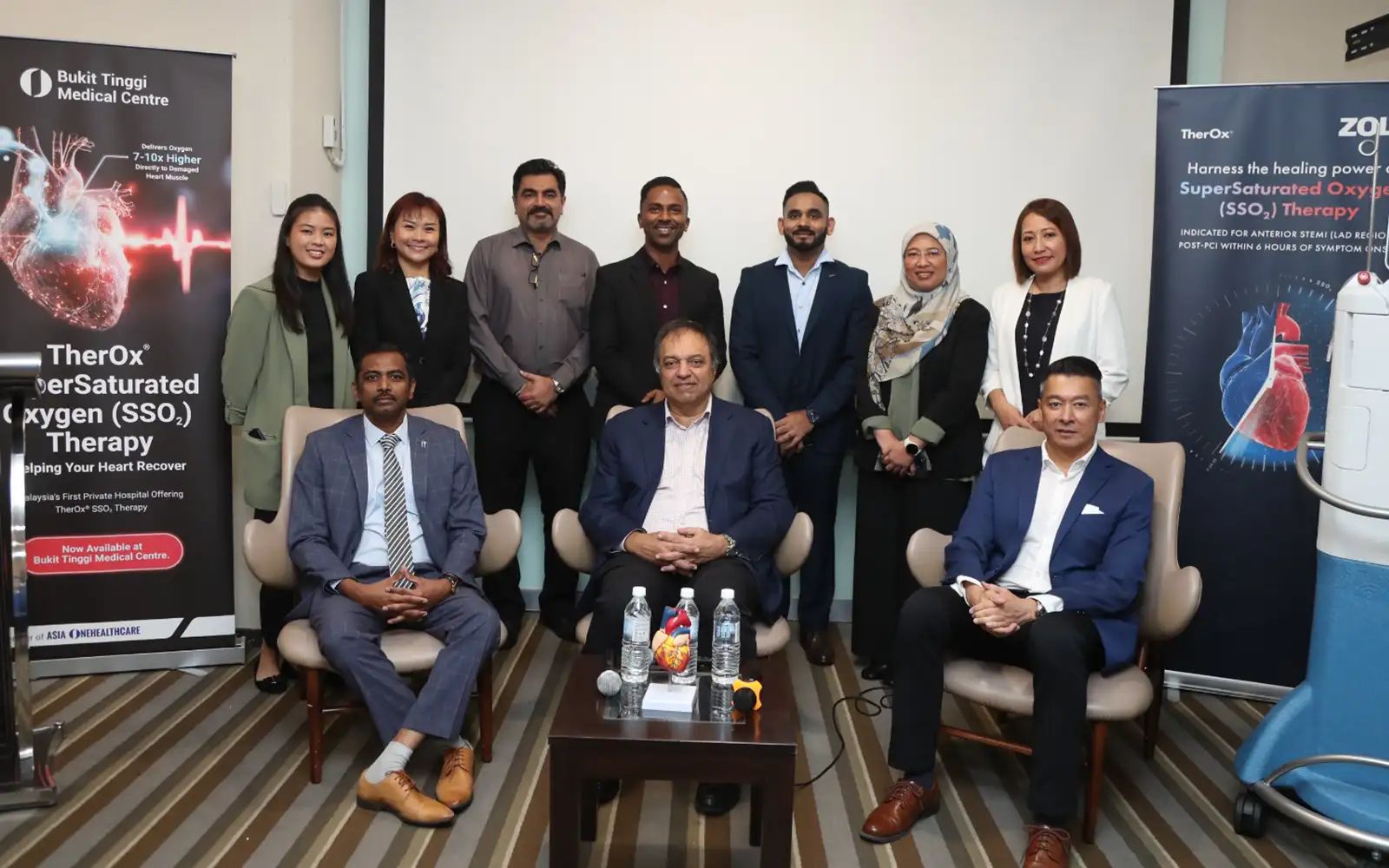
“When a patient has a heart attack, we will open up the big blood vessels – that is our main procedure,” said Dr Shathiskumar Govindaraju, consultant cardiologist at BTMC.
In simple terms, a heart attack occurs when blood flow carrying oxygen to the heart is suddenly blocked, most commonly due to a clot in a narrowed coronary artery. Treating that blockage quickly is critical to restoring blood flow and limiting acute damage.
While angioplasty – a procedure to open blocked coronary arteries – and stenting, which involves placing a small mesh tube to keep the artery open, can restore blood flow and have rescued countless lives, there is another challenge: studies have shown that it does not always restore oxygen delivery to the heart’s smaller blood vessels.
These tiny blood vessels can remain blocked or injured. As a result, parts of the heart may still be starved of oxygen, even after what appears to be a successful procedure. This may lead to permanent heart muscle scarring, reduced heart function, and a higher risk of heart failure in the long term.
According to Shathiskumar, heart failure develops in one out of five patients after stent implantation. There is no cure for heart failure, treatment can be costly, and it can severely affect a patient’s quality of life.
“Life becomes very difficult for them. Even walking to the toilet or lying down can be very hard because of fluid accumulation in the legs and lungs. There’s a lot of suffering that they go through,” said Shathiskumar.
So, how does TherOx® SuperSaturated Oxygen (SSO2) Therapy help?
The treatment works by increasing the amount of oxygen carried in the blood. This oxygen-rich blood is created by combining highly oxygenated saline with the patient’s own blood, which is then delivered directly to the heart through a small catheter for an hour.

Because oxygen is carried in a dissolved form, it can reach areas of the heart where blood flow is limited, helping improve oxygen delivery to the heart’s smaller blood vessels.
Beyond this, the therapy may help reduce permanent damage to the heart muscle and support better recovery of heart function, among others.
Still, angioplasty and stenting remain the standard and essential first steps in treatment, with the therapy used as an additional measure.
The procedure was successful and the patient recovered well following the treatment.
According to Dr Sivah Sandrasakre, clinical evidence manager of ZOLL Medical Corporation, BTMC became the first private hospital in the Asia Pacific region to offer this therapy.
For the patient, the experience has been life changing.
“I feel very grateful to everyone who has helped me. This experience has given me a second chance in life, and I now appreciate things much more. I focus more on myself, my family – and of course, my health,” he said.
Learn more about Bukit Tinggi Medical Centre on its website, Facebook and Instagram.