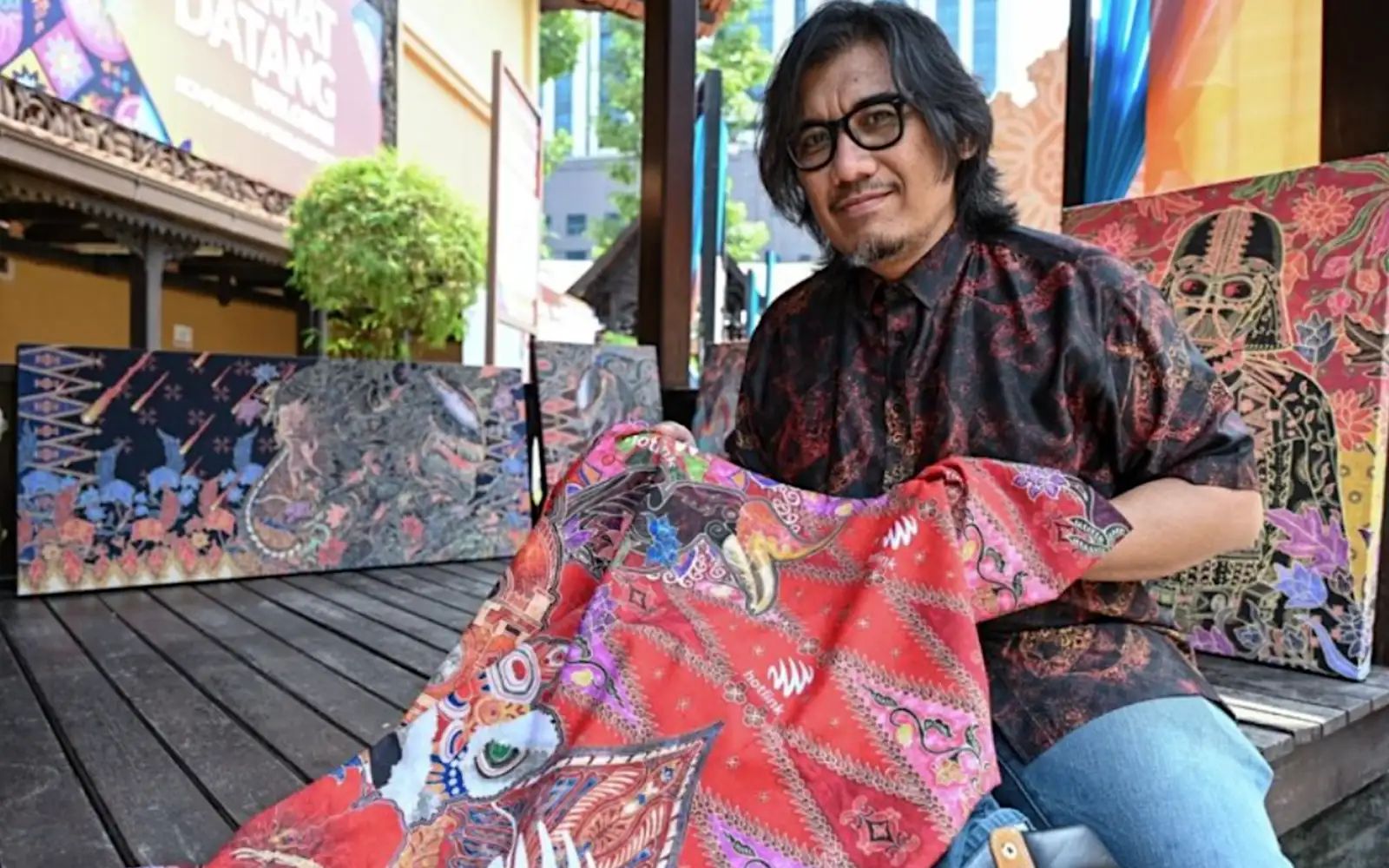
For the 48-year-old, every motif is carefully selected to allow viewers to explore multiple layers of meaning, from historical narratives and local cultures to the lived experiences of the communities he highlights through his art.
Better known as Superdoofus, Arif is known for creating works that reflect unity and cultural diversity, showcasing the identities of Malaysia’s various ethnic groups.
“This piece has a map featuring different motifs for each state – for example, the fan represents the Chinese community, houses of worship and so on,” he told Bernama, holding up an artwork during the recent Malaysia Batik Day celebration here.
“But the main element is the cempaka flower, the backbone that supports all these elements of harmony. It is a link to the nation’s identity, because most batik motifs feature this flower. The artwork shows how different races and states come together as one country.”
Beyond batik’s role in fashion, Arif believes the form can remain relevant through visual art, which can serve as a medium of storytelling.
“In the 1990s, there was a trend where modern clothing were folded at the hem and batik patterns were sewn onto the fold. I saw a lot of people wearing that, but the trend was short-lived because batik was used merely as decoration.
“There was no storytelling behind those batik elements; they were simply motifs that followed a trend,” he noted. “Batik can definitely be trendy, but it needs relevance for it to last – meaning it must have a story so it can endure.”

Having ventured into illustration in 2014, Arif said his style is influenced by personal experiences and his passion for blending local cultural elements with social messages. Among his notable creations is an artwork created in solidarity with the Palestinian struggle.
“I included elements of tatreez, or Palestinian embroidery, and merged them with Malaysian batik to tell a story about Palestine. I used watermelon colours as a symbol of the fruit itself, which represents resilience,” he explained.
The combination of batik and tatreez, he added, makes the piece not only visually appealing but also deeply symbolic of the connection between the two nations.
Asked on the future of batik, Arif pointed out that its evolution is no longer confined to traditional patterns or specific colours. Instead, motifs and styles are now shaped by changing public tastes and the digital era.
“Times change, and Malaysian batik has its own evolution, too,” he said. “It’s moving towards abstraction, with fewer floral motifs and more lines, dots, squares and swirls.
“Malaysia is evolving, so there’s no such thing as ‘you must stay inside this box forever’.”