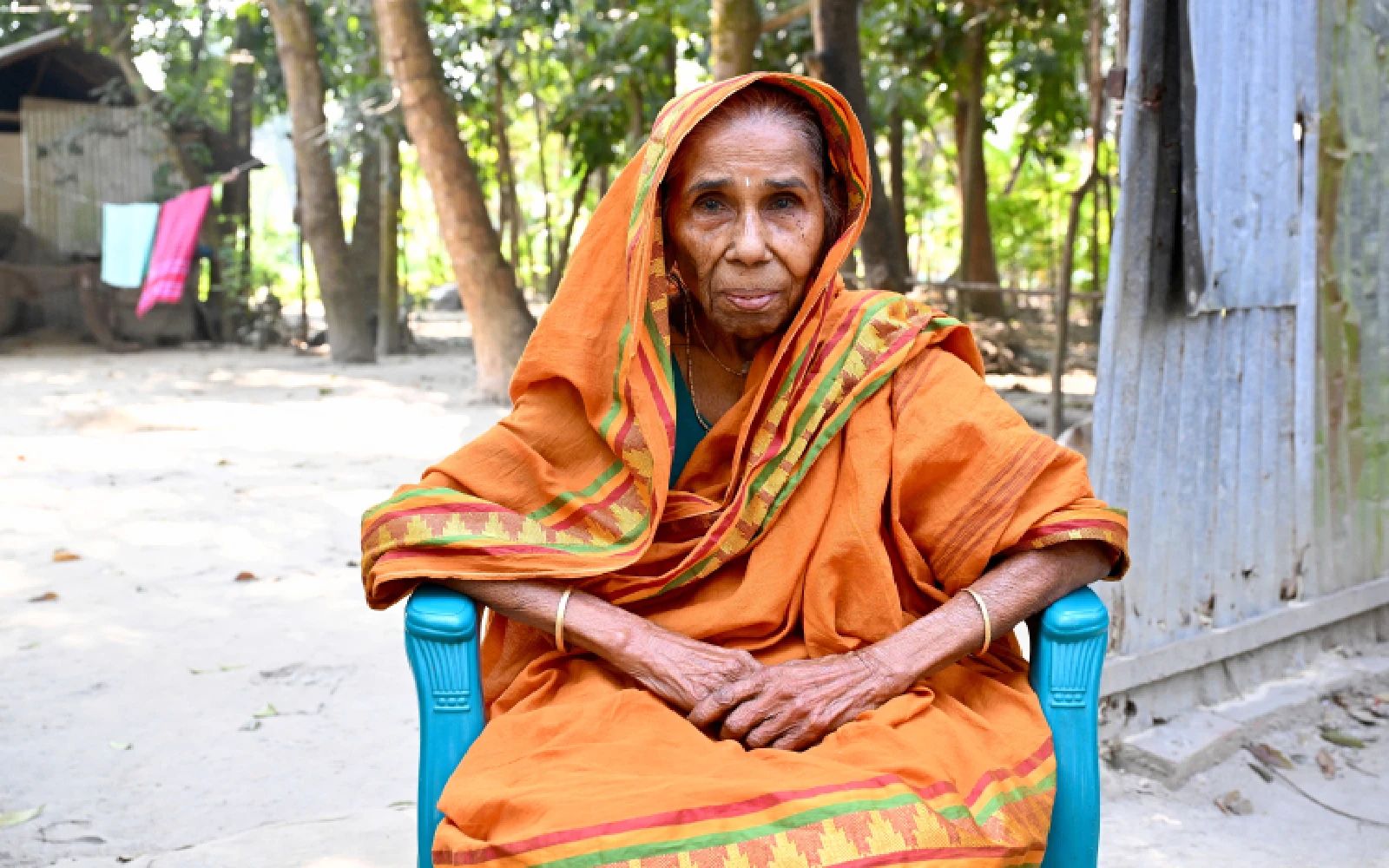
Her longing reflects the anxiety felt by many of Bangladesh’s 13.1 million Hindus, the country’s largest religious minority, after at least 70 people were killed in unrest following a student-led uprising.
Only four percent of candidates standing for election come from minority backgrounds in the country of 170 million, according to official data, leaving them poorly represented in parliament.
“I pray and hope that peace will prevail… that people of all faiths will coexist forever,” Biswas, 92, said outside her ancestral home in Abhaynagar, where three generations of her family were born.
Hindu families in Biswas’s village in Jessore district have twice fled communal attacks — first during the 1971 Liberation War, and again as election-related violence struck in 2014.
“I had just given birth then (in 1971),” Biswas recalled, her voice quivering.
“I walked for five days with thousands of others carrying my seven‑day‑old baby before reaching a refugee camp in India.”
Biswas returned to her home in Bangladesh many months later but without her baby, who died within two months of her escape.
Elections have long stirred unease among minorities in Muslim-majority Bangladesh following large-scale violence during the 2001 and 2014 polls.
Hindus have often been targeted for their perceived loyalty to the now‑banned Awami League of former prime minister Sheikh Hasina, who was ousted in the uprising in July 2024.
Hasina has since been living in Hindu-majority India, her old and trusted ally.
Changed approach
Thursday’s election mainly pits the Bangladesh Nationalist Party (BNP) against the Islamist Jamaat‑e‑Islami, who have both promised communal harmony.
Jamaat is even fielding a Hindu candidate this time — a rare move for the Islamist party.
“We have always been used as pawns,” said fish trader Shekhar Kumar Barman, 47. “We will vote only if it remains peaceful.”
The BNP is fielding six minority candidates, while Jamaat nominated Krishna Nandy from a Hindu‑majority constituency long held by the Awami League.
“Jamaat‑e‑Islami has changed its approach,” Nandy told AFP at a campaign rally.
“If I become a minister, Hindus will be protected and won’t have to live in fear.”
Political commentator Mohiuddin Ahmed said parties mainly pick minority candidates for optics.
“None of the established political parties — including the Awami League and the BNP — are secular,” Ahmed told AFP.
“They only want votes, which is why they field Hindu candidates in Hindu-majority areas.”
Hindus made up 14.6 percent of Bangladesh’s population after independence in 1971, but their share has declined sharply to less than 10 percent in the officially secular country.
Burned alive
Bangladesh saw a fresh wave of communal violence following the anti-Hasina uprising.
Houses, places of worship and shops belonging to religious minorities were attacked across the country in the immediate aftermath, Amnesty International said.
The Bangladesh Hindu Buddhist Christian Unity Council reported more than 500 attacks in 2025, including sexual assault and arson.
The interim government led by Muhammad Yunus has downplayed the violence, attributing many incidents to criminal motives.
A series of attacks was also reported in December after the murder of Sharif Osman Hadi, a popular uprising leader and a vocal critic of India.
The lynching of Hindu garment factory worker Dipu Chandra Das following blasphemy allegations further stoked fear among minorities.
He was reportedly tied to a tree and set on fire.
“We want the administration to protect us so that our mothers and daughters can live with dignity,” said Mohon Sarkar, a fish trader.
“The world witnessed how a Hindu man was burned alive,” he said, referring to Das. “We urge the government to ensure security for all.”
Rights group Ain o Salish Kendra (ASK) said authorities must address communal tensions before polling day.
“Past election violence still haunts minority communities,” senior ASK coordinator Abu Ahmed Faijul Kabir told AFP.
“The state must guarantee security, dignity and equal participation for every citizen.”