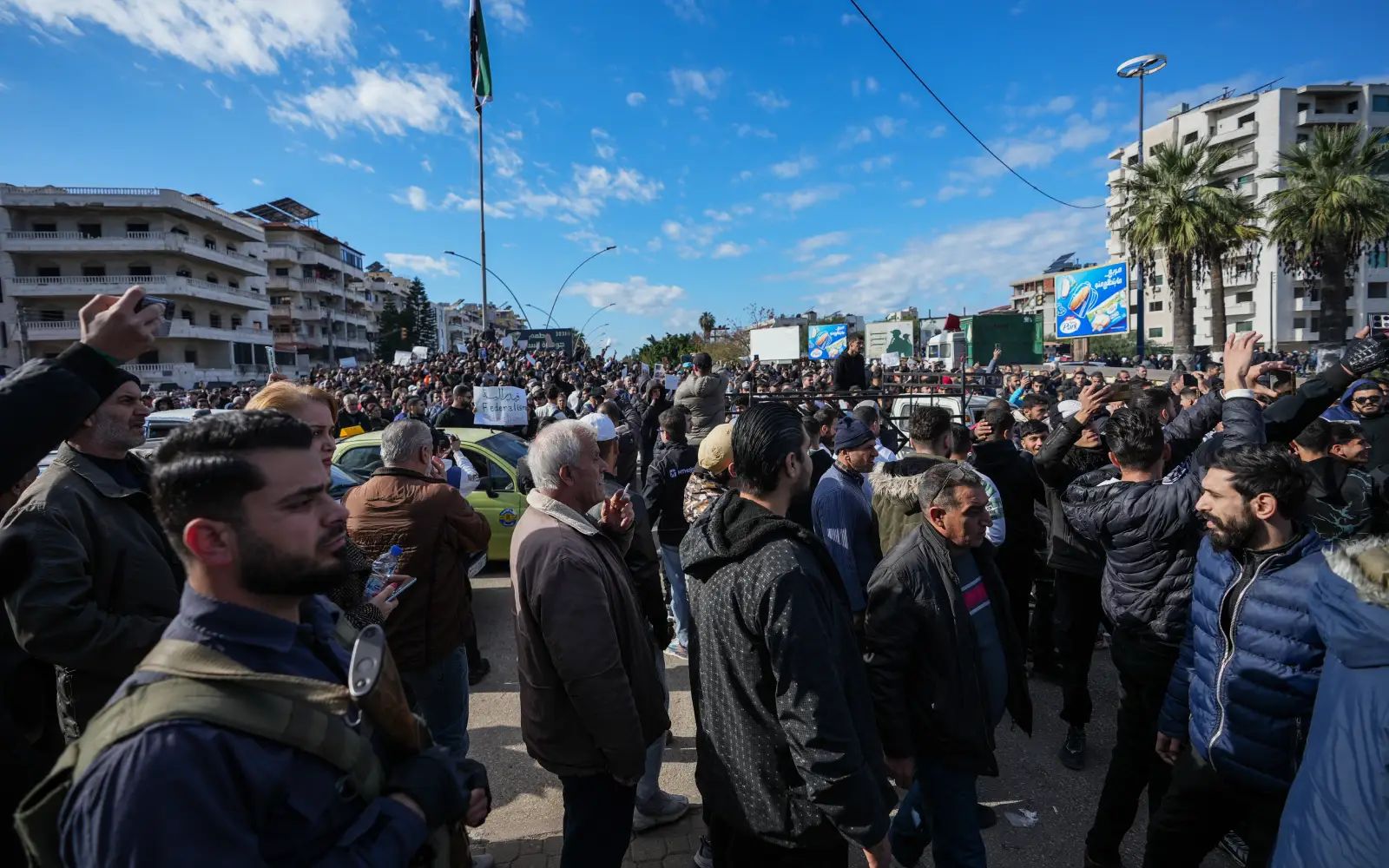
The Syrian Observatory for Human Rights reported the two deaths in the coastal city, and a medical source told AFP two bodies had been taken to a local hospital.
Syrian authorities did not confirm opening fire but said they had “contained the situation” and accused “remnants” of former ruler Bashar al-Assad’s government of attacking security forces.
Thousands of Syrian Alawites gathered in coastal and central parts of the country on Sunday to protest after Friday’s bombing at a mosque in an Alawite area of Homs city that killed eight people.
AFP correspondents in Latakia and the town of Jableh saw security forces intervene to break up clashes between demonstrators and supporters of Syria’s new Islamist authorities, firing gunshots in the air.
The Observatory also reported violence in the city of Homs itself, with several injured.
AFP’s correspondent in Latakia said that Syrian forces were later deployed to disperse government supporters.
The attack, which was claimed by a Sunni extremist group known as Saraya Ansar al-Sunna, was only the latest against the religious minority, which has been the target of several episodes of violence since the December 2024 fall of Assad, himself an Alawite.
“Why the killing? Why the assassination? Why the kidnapping? Why these random actions without any deterrent, accountability or oversight?” said Numeir Ramadan, a 48-year-old trader protesting in Latakia prior to the clashes.
“Assad is gone, and we do not support Assad… Why this killing?”
‘Determine our destiny’
Sunday’s demonstrations came after calls from prominent spiritual leader Ghazal Ghazal, head of the Islamic Alawite Council in Syria and Abroad, who on Saturday had urged people to “show the world that the Alawite community cannot be humiliated or marginalised”.
“We do not want a civil war, we want political federalism. We do not want your terrorism. We want to determine our own destiny,” he said, in a video message on Facebook.
Later on Sunday, the council shared a statement on Facebook accusing authorities of attacking “unarmed civilians” demanding their “legitimate rights”, while telling supporters to return home.
Protesters carried pictures of Ghazal along with banners expressing support for him while chanting calls for the new authorities to allow for decentralised government authority and a degree of regional autonomy.
Placards also called for an end to “sectarian speech”.
“Our first demand is federalism to stop the bloodshed, because Alawite blood is not cheap, and Syrian blood in general is not cheap. We are being killed because we are Alawites,” Hadil Salha, a 40-year-old housewife said.
Most Syrians are Sunni Muslim, and the city of Homs – where Friday’s bombing took place – is home to a Sunni majority but also has several areas that are predominantly Alawite, a community whose faith stems from Shiite Islam.
The community is otherwise mostly present across their coastal heartland in the Latakia and Tartus provinces.
Since Assad’s fall, the Syrian Observatory for Human Rights monitor and Homs province residents have reported kidnappings and killings targeting members of the minority community.
Alawite massacres
The country has seen several bloody flare-ups of sectarian violence.
In March, Syria’s coastal areas saw massacres of Alawite civilians, with authorities accusing armed Assad supporters of sparking the violence by attacking security forces.
A national commission of inquiry said at least 1,426 members of the minority were killed, while the Syrian Observatory for Human Rights monitor put the toll at more than 1,700.
Late last month, thousands of people demonstrated on the coast to protest fresh attacks targeting Alawites in Homs and other regions.
Before and after the March bloodshed, authorities carried out a massive arrest campaign in predominantly Alawite areas, which are also former Assad strongholds.
On Sunday, protesters also demanded the release of detainees.
On Friday, Syrian state television reported the release of 70 detainees in Latakia “after it was proven that they were not involved in war crimes”, saying more releases would follow.
Despite assurances from Damascus that all Syria’s communities will be protected, the country’s minorities remain wary of their future under the new Islamist authorities, who have so far rejected calls for federalism.