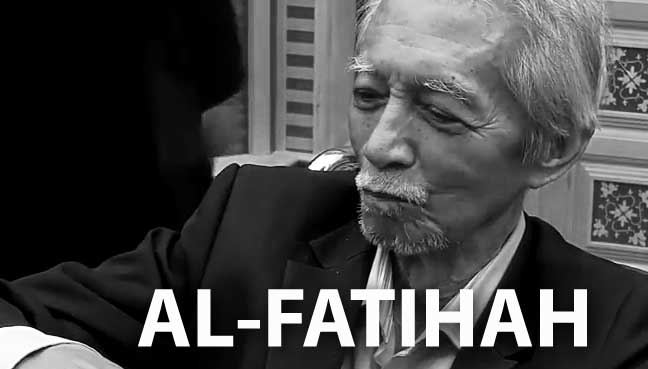
Kassim’s son Ahmad Shauqi confirmed that his father was hospitalised for a lung infection and a blocked heart valve on Sept 16.
Shauqi was reported as saying last night that his father had difficulty breathing and was using an oxygen mask.
He rushed to the hospital to see his father after his sister in Kulim called him in Penang and informed him his father was in critical condition.
Shauqi said he was upset with the religious authorities for the strain imposed on his elderly father who had faced charges that he had insulted Islam and defied the religious authorities.
The Shariah High Court later acquitted and discharged Kassim after ordering the withdrawal of the charges.
“I’m going to make sure the lawyer who defended my father sues them, for giving him all this trauma,” Shauqi said.
“He’s a learned man and he’s not a violent man. He’s a very calm person, but it is sad how society has treated him. He sacrificed his life for the people.”
Kassim had just celebrated his 84th birthday on Sept 9, one week before he was hospitalised.
He leaves behind his wife, Shariffah Fawziah Syed Yussoff Alsagoff, whom he married in 1960, two daughters and a son.
Kassim was born in 1933 in Bukit Pinang, Kota Setar, the first child of an Islamic religious teacher. After finishing his studies, he became a teacher and taught in Penang.
He also pursued his interest in politics and eventually became head of the Malaysian socialist party. He was jailed for nearly five years under the Internal Security Act (ISA) for his political views.
With his love for literature, he also became a famous poet in his own right and a famous, albeit controversial, writer too. That eventually led to him renewing his interest in Islam since the early 1970s.
This affected his position in his party, so he decided to quit as chairman in 1984. He then joined Umno in 1986, and after failing in his attempt to bring reforms into the party, which was led by Dr Mahathir Mohamad at the time, quit active politics in 1992.
Kassim is best known for his literary works, “Universiti Kedua” (Second University), which included his experience of being detained under the ISA, and “Hadith: A Reevaluation”, a critical study on the authority of the Hadith as a source of Islam.
Aside from an honorary Doctorate in Letters conferred by Universiti Kebangsaan Malaysia (UKM), he has not received any accolade from the government for his contribution to literature and other intellectual works.