
Reading is often described as a bridge to knowledge – a familiar refrain in campaigns promoting literacy nationwide. And on World Braille Day today, this saying carries even more weight.
Yet beyond well-meaning efforts lies a group that has struggled to cross that bridge: children with visual impairments, who continue to face limited access to reading materials because of a shortage of Braille books.
Increasingly, visually impaired children depend on audio materials, smartphones and digital tools, leading to a gradual erosion of tactile reading skills – even though Braille remains the cornerstone of their education.
Without Braille, children lose vital opportunities to understand spelling, sentence structure and vocabulary. Audio resources may provide information, but they cannot replace the tactile experience essential for the mastery of language.
Hakimi Hassan, founder and trustee of the Malaysian Foundation for the Blind (YOBM), describes the problem as structural and long-term.
“If even newly published books are not available in Braille, how are students expected to familiarise themselves with the reference materials they need?” he said in an interview with Bernama, warning that Braille literacy risks further decline as education shifts towards digital access.
While online and audio materials have their place, Hakimi stressed that they cannot replicate the tactile function of Braille, which is critical for learning spelling patterns, syllable structure and vocabulary development.
To address this gap, YOBM launched the Illustrated Malay-English Braille Dictionary for Children project in March 2025 – the first of its kind in Malaysia.
So far, more than 230 volumes have been distributed to three special education schools – SK Klang, SKPK Jalan Batu and SMKPK Setapak – with plans to reach 35 schools nationwide by next year.

“A bilingual dictionary is a basic necessity,” Hakimi said. “To date, none has been provided for visually impaired students. Sighted pupils can simply buy one from a bookstore. Blind children do not have that option.”
Created as a child-friendly mini encyclopaedia, the dictionary pairs alphabets with images to support early comprehension. But producing a Braille book is far more complex than standard printing.
A single Braille character occupies nearly four times the space of a printed letter. As a result, a 10-page textbook can expand into 40 pages in Braille. What would normally be a slim A-to-Z book ultimately became five separate volumes.
Content was carefully pared down, with non-essential graphics removed and layouts simplified to ensure pages remained manageable for young readers learning tactile literacy.
The dictionaries are tailored to different levels of visual impairment – from pupils who rely entirely on Braille to those with limited vision who benefit from a combination of Braille and high-contrast images. These visuals help children form mental representations of objects and prevent “conceptual blindness” as vision deteriorates.
However, producing such materials is costly. Colour ink must be original to avoid damaging printers, which are not designed for heavy workloads. Hakimi estimates that a RM500 printer lasts only a few months before needing repair or replacement.
Braille books also have a shorter lifespan. Embossed dots begin to flatten after six to seven months if not carefully handled, requiring frequent reproduction.
YOBM currently operates just two embosser units imported from Sweden – expensive machines with high maintenance and spare-part costs.
“If one breaks down, our production capacity drops by half,” Hakimi said, adding that since the project began, total costs have reached hundreds of thousands of ringgit.
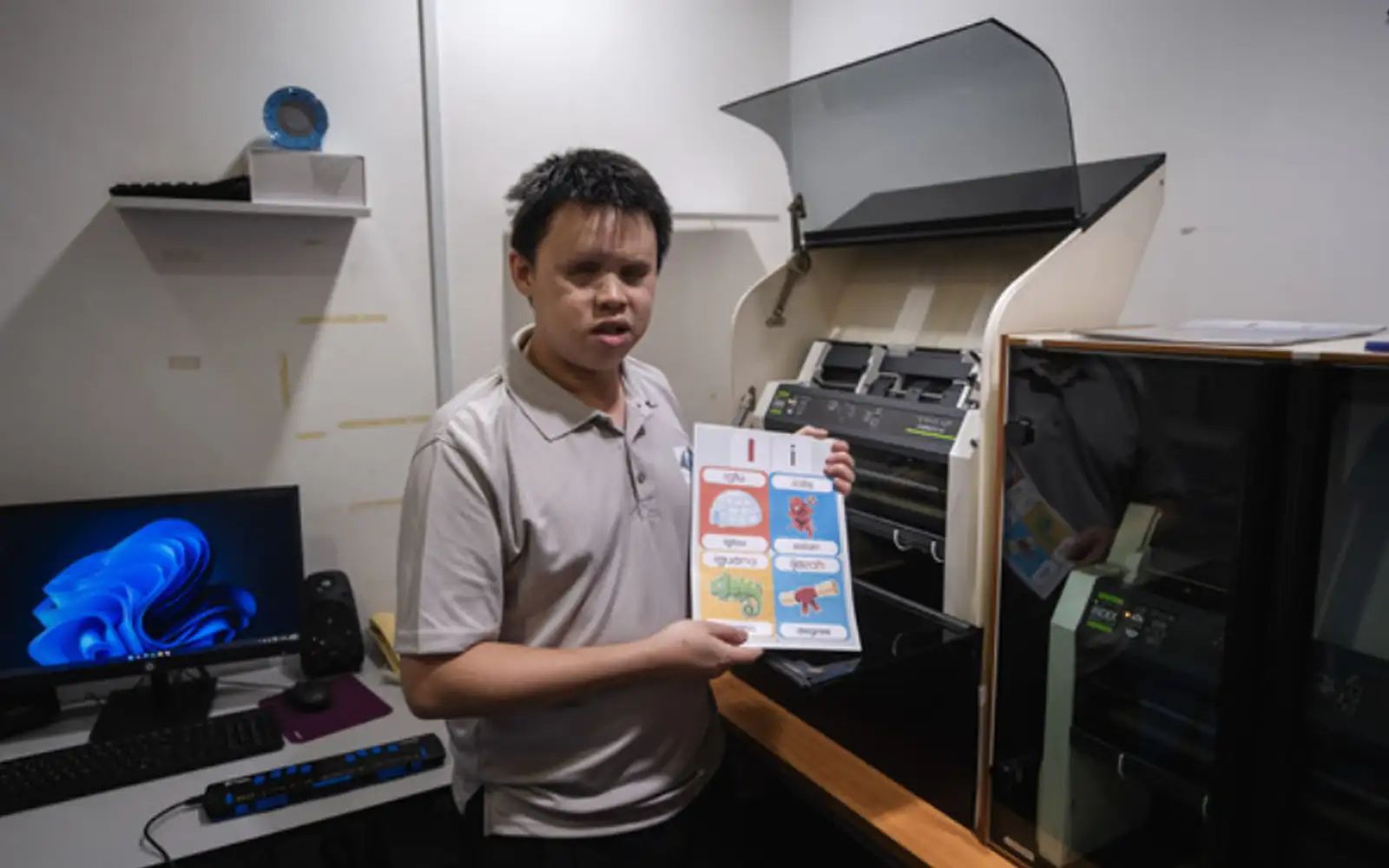
“Every Braille character must be exact,” he said. “I type the text using a specialised Braille keyboard, review it, then convert it using software. Layout and spacing are adjusted precisely before printing.”
Despite technological assistance, production remains slow, with only about 10 complete sets produced per day. Each sheet must be fed individually, and any error affects both text and images, requiring constant supervision.
YOBM’s work began with an adult bilingual Braille dictionary, an effort constrained by cost and technical limitations but rich in lessons.
“That project opened our eyes to the scale of the Braille literacy gap,” Hakimi said.
It also highlighted the need for child-specific materials. Teachers emphasised that children require simple, illustrated and consistent vocabulary – not adaptations of adult content.
Research and development involved collaboration with special education teachers, academics and the Ministry of Education, as well as studies of mainstream children’s books adapted for blind learners.
Looking ahead, YOBM plans to develop multilingual dictionaries and a digital library featuring text-to-speech tools, audiobooks and additional learning modules.
“We want Braille literacy to be a right, not a privilege,” Hakimi said, outlining the foundation’s vision of a more inclusive learning ecosystem – and a more independent future for visually impaired children.