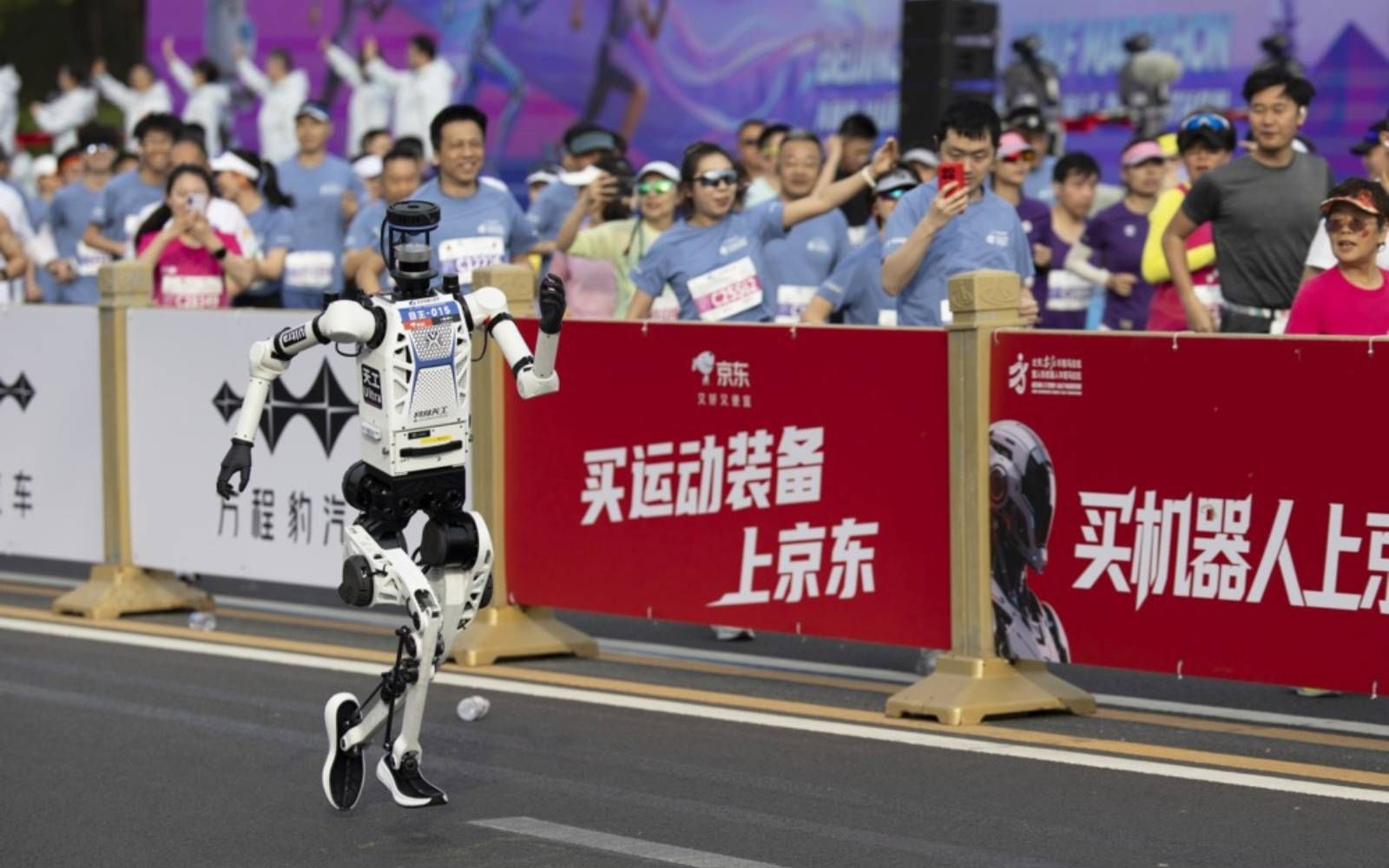
Unitree Robotics, one of the most recognisable names in the industry after its robots practicing martial arts made headlines, on Monday received approval for a listing in Shanghai. Its IPO will serve as an early test for what could be a broader wave of offerings.
Hong Kong alone has at least 46 robotics-related companies in the pipeline, more than 10% of applicants, according to a report. Companies that have filed IPO applications include Leju Robotics and Deep Robotics.
“Chinese humanoids are one step closer to IPOs, igniting market interest on humanoids in the second half of 2026,” Sheng Zhong, head of China industrials research at Morgan Stanley, wrote in a note. “Funds from most of the Chinese humanoids’ IPOs will go toward R&D, especially robot models.”
The deep pipeline of robotics IPOs mirrors the fast rise of China’s AI ecosystem, where an array of listings whipped up an investor frenzy in the past six months.
It also aligns with Beijing’s push to shift high-tech industries from innovation to large-scale deployment. China is rushing to set the pace of funding, industrialisation and ultimately leadership in what Nvidia Corp CEO Jensen Huang calls “physical AI.”
Shares of OneRobotics (Shenzhen) Co jumped as much as 18% in Hong Kong on Tuesday, while component maker Leader Harmonious Drive Systems Co gained as much as 11% on the mainland.
“This is the decade of the robot – and it belongs to China,” Barclays analysts including Zornitsa Todorova wrote in a note last month. “This leadership reflects a decade-long, state-guided push.”
The firm says China’s robotics roll-out is already unmatched, accounting for 50% of global industrial robots and 85% of humanoids in 2025. Backed by coordinated industrial policy and tight supply-chain control, humanoids could reach about 3.8% of the nation’s labour capacity by 2035, it estimates.
Unitree got a nice shoutout from Nvidia’s Huang on Monday, when he showcased his company’s endeavors in robotic AI. The two companies have partnered to build humanoid “reference” machines, featuring five-fingered hands and built-in chips to replace cumbersome “Frankenrobots” in research labs.
Some investors remain more cautious, though, when looking at the companies’ fundamentals. Many robotics firms are expected to burn cash for years and concerns are mounting that valuations could run ahead of earnings.
A gauge of humanoid robot stocks has fallen about 13% this year, after registering a 47% gain in 2025. ChinaAMC CSI Robot ETF, a major exchange-traded fund tracking robot-related stocks, has seen net fund outflows for most of this year.
Valuations were also elevated, with the sector trading at about 40 times forward earnings, compared with about 14 times for the CSI 300 Index, according to Bloomberg-compiled data.
“Investors trading at such elevated valuations are typically not driven by long-term fundamentals, but rather by the pursuit of short-term price gains,” said Shen Meng, a director at Beijing-based investment bank Chanson & Co. “It indicates that sentiment is driven more by market dynamics than by conviction or long-term vision.”
The state-run China Securities Journal also struck a cautious tone in an editorial published Tuesday, warning that pre-IPO valuations may outpace fundamentals, with many firms still unprofitable, raising the risk of a sharp correction if growth or commercialisation disappoints.
Still, prospective issuers can look at the performance of China tech IPOs this year, with many listings thousands of times oversubscribed and producing big gains on their debuts.
Two of those companies, AI model developers Knowledge Atlas Technology Joint Stock Co and MiniMax Group Inc last month gained inclusion in the Hang Seng Tech Index after massive rallies since their January listings.
For investors, the robotics companies can also offer a way to benefit from the rapid expansion of a cutting edge industry, said Zhou Nan, founder and investment director of Shenzhen Long Hui Fund Management Co.
“With continued advances in AI, the robotics sector is poised for substantial long-term growth,” Zhou said. “Robotics is expected to become a key driver of enterprise value, and progressively complement or replace human labour across a wide range of use cases.”