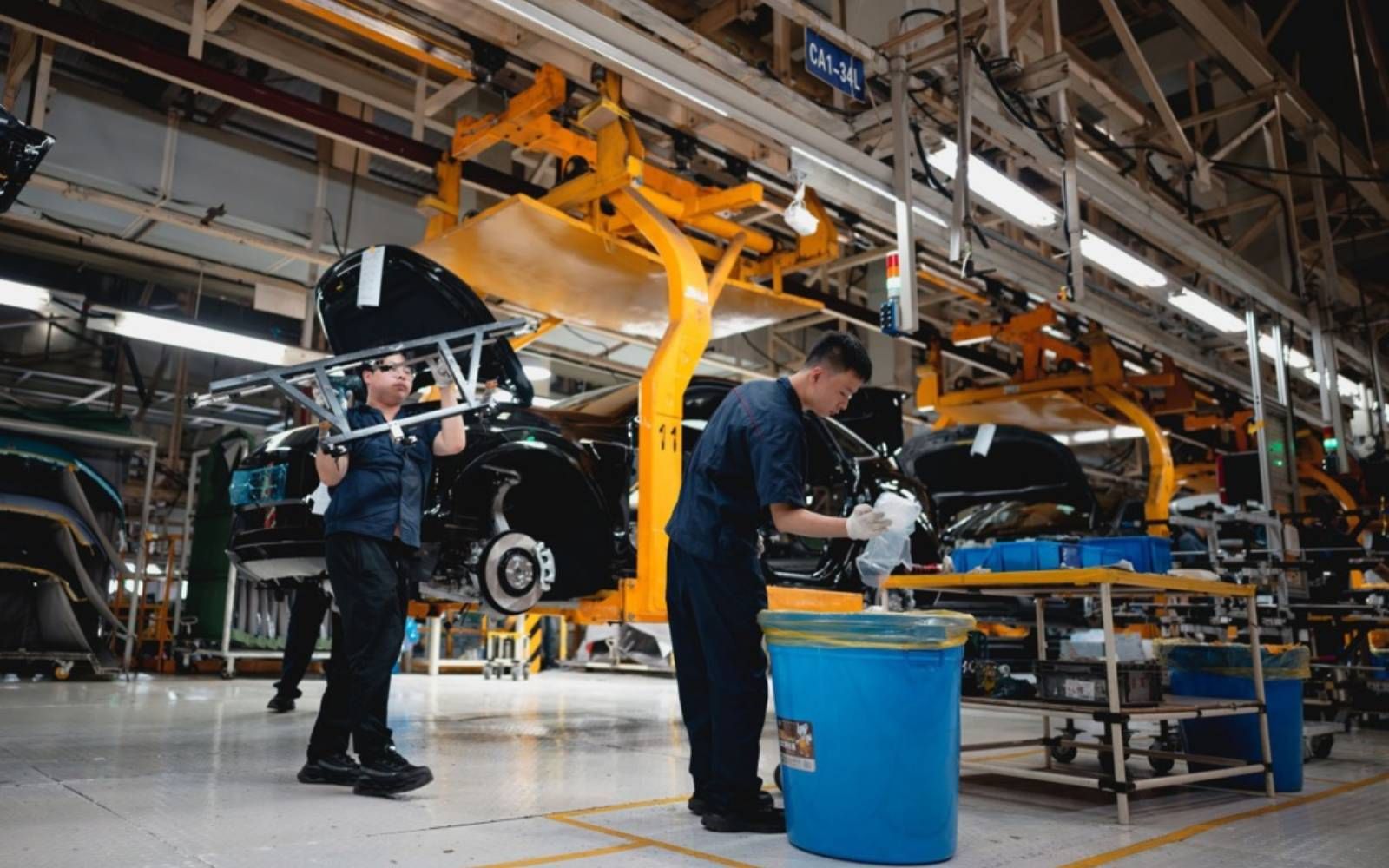
The world’s second-largest economy has been struggling with a slowdown in domestic demand and investment in recent years that has weighed on its vast manufacturing sector.
Despite this, the manufacturing purchasing managers’ index – a key measure of industrial health – rose to 50.4 in March, according to the National Bureau of Statistics (NBS).
That figure was up from 49.0 in February and 49.3 in January, and beat a forecast of 50.1 in a Bloomberg survey of economists.
It is the highest since March 2025 when the PMI was 50.5.
NBS statistician Huo Lihui attributed March’s expansion to the “resumption of work and production after the Spring Festival”, which led to increased market activity.
There was an acceleration in the production activities of manufacturing enterprises and a marked improvement in market demand, Huo said.
China’s non-manufacturing PMI – a gauge of activity across services and construction – was 50.1 in March, an improvement from February’s slump of 49.5.
The data has underscored some resilience in China’s economy despite the uncertainty that the raging Middle East war has brought about, after US-Israeli strikes on Iran triggered Tehran’s retaliation that sharply restricted access to the Strait of Hormuz.
The waterway is a critical shipping route for energy resources, and the situation has caused global oil prices to soar, triggering fears for the world economy.
The outlook for the second quarter is unclear, and the market is “increasingly worried” about the risk of global growth slowdown and supply chain disruption, Zhiwei Zhang, president and chief economist at Pinpoint Asset Management, wrote in a note.
“While China has ample energy reserves to mitigate the term of trade shock, a global growth slowdown would dampen China’s exports,” Zhang said.
China’s trade surged by a fifth in the first two months of the year, official data showed earlier this month, significantly outpacing forecasts despite a plunge in shipments to the United States.
The country also achieved a record trade surplus last year, offering a crucial lifeline for Beijing as domestic activity slumped.